 arXiv
arXiv GitHub ↗
Predict
The speech-conditioned sampler estimates the next motion latent.
 InteractGesture
ECCV 2026Workshop · Interactive Social Avatars ↗

* Work conducted during an internship at Meta.
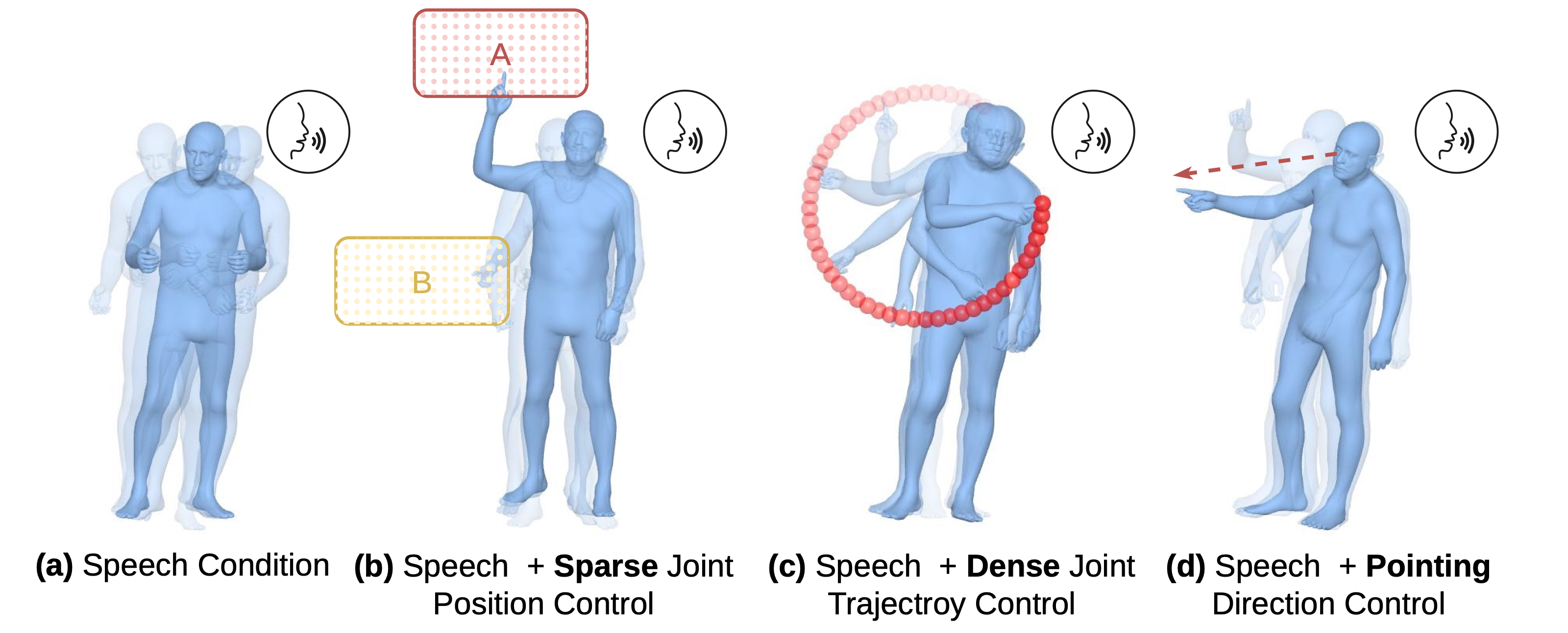
Supports multiple applications. Place a joint at a keyframe, draw a continuous trajectory, or direct an arm toward a target.
InteractGesture guides individual joints toward user-defined 3D targets while preserving natural, speech-aligned motion—without retraining the gesture model.
01 / Motivation
Speech-driven models produce plausible gestures, but animators cannot tell a hand where to land or a finger where to point. Directly fixing poses after generation often looks unnatural, and independently generated chunks break motion around their boundaries.
InteractGesture solves both problems at inference time: spatial errors from the future flow through a differentiable motion decoder, while overlapping chunks remain editable as new audio arrives.
02 / Method
The pretrained generator stays frozen. At selected sampling steps, its latent estimate is decoded into SMPL-X joints, compared with the controlled targets, and adjusted using the spatial loss.
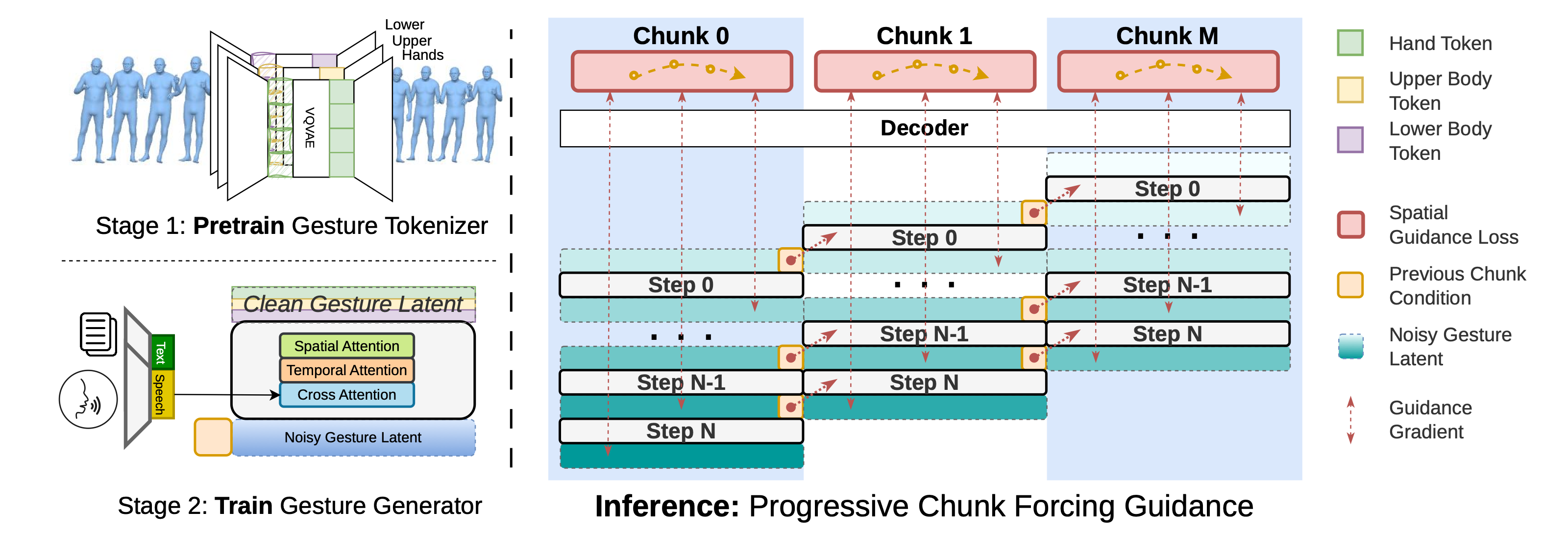
The speech-conditioned sampler estimates the next motion latent.
A differentiable RVQ-VAE and SMPL-X recover the 3D joints.
Spatial loss gradients move selected joints toward their targets.
03 / Continuous Control
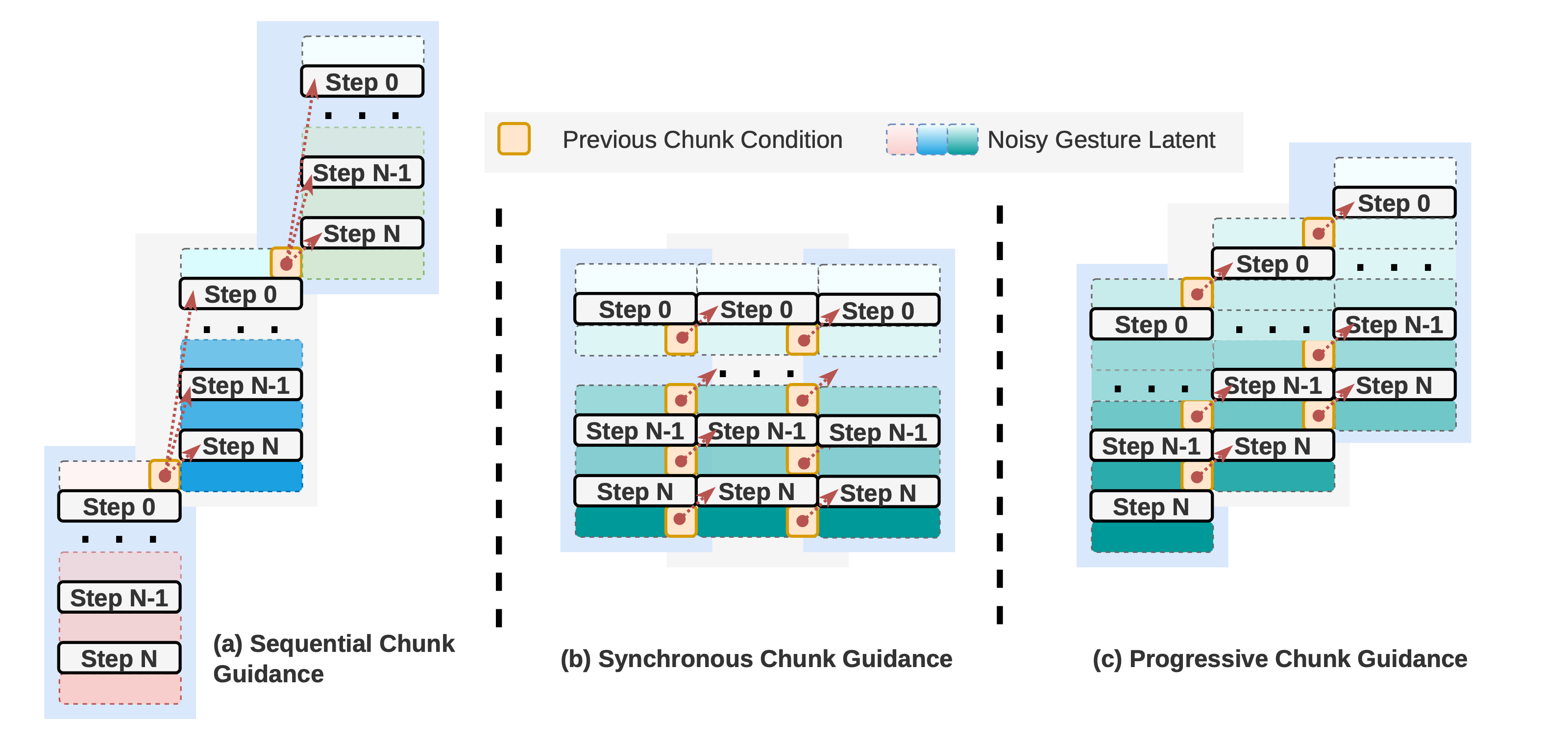
Progressive Chunk Guidance introduces motion chunks with a staggered delay and keeps an active window editable. A target in the incoming chunk can therefore smooth the trajectory that leads into it—without waiting for the full speech sequence.
04 / Results
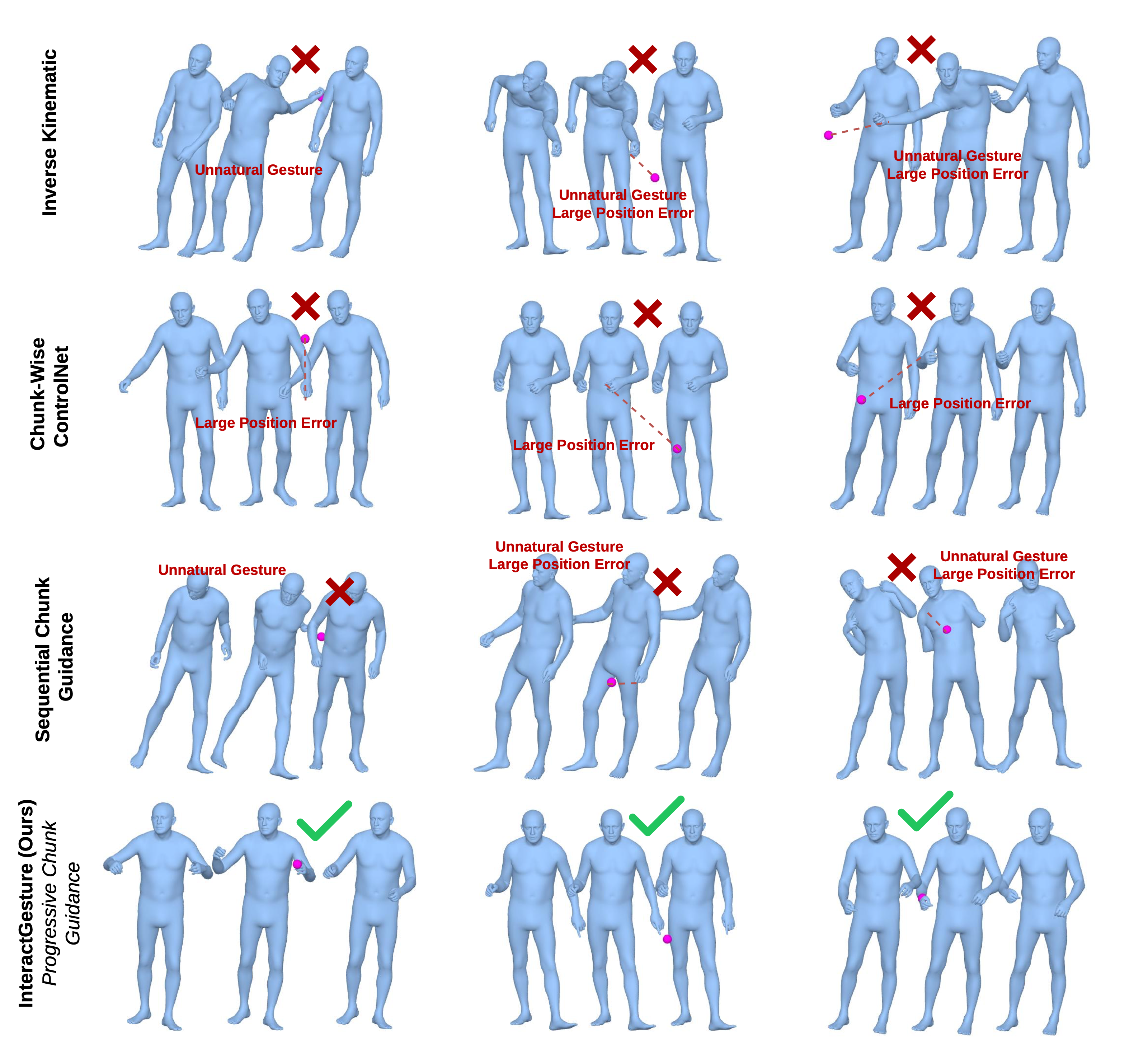
On BEAT2, progressive guidance reaches spatial targets far more accurately than sequential guidance, inverse kinematics, or chunk-wise ControlNet—while retaining the best generated-motion FGD.
In one sentence